


The other day, I wrote about why branding and innovation are essential for companies that want to remain competitive and sustainable over the long term on LinkedIn. In this article, I take a deeper look at OnePlus as a case study—and the lesson it teaches about how brand perception is shaped by actions, not words.
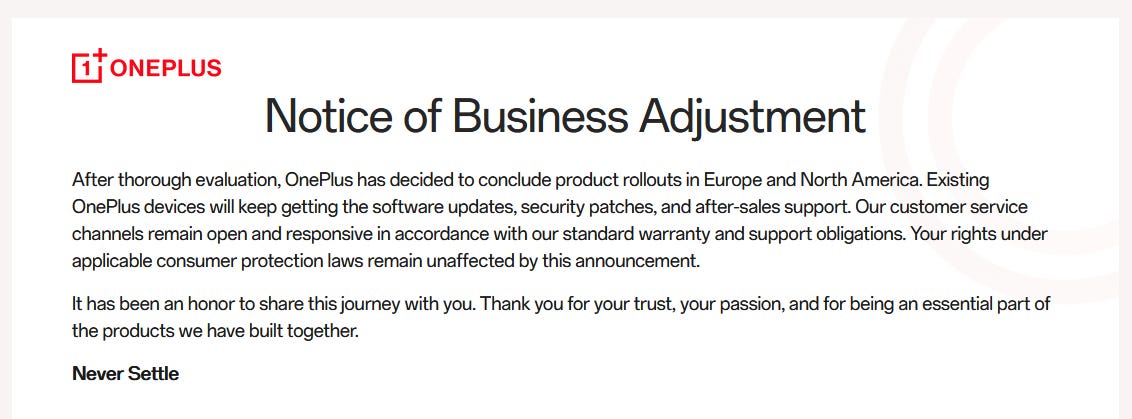
The recent—though arguably long overdue—announcement from OnePlus provides an interesting case study.
OnePlus was founded in December 2013 by Pete Lau, then Vice President of OPPO, and Carl Pei, who later founded and now leads Nothing.
From the outset, OnePlus benefited from access to OPPO’s manufacturing expertise and supply chain. This allowed the company to produce premium hardware without the enormous capital investment typically required to build manufacturing facilities from scratch.
The company’s mission was simple: consumers were paying increasingly higher prices for flagship smartphones, and OnePlus believed there was a better way. Its goal was to deliver flagship-level performance, clean and fast software, and premium build quality—all at a significantly more competitive price.
Its slogan, “Never Settle,” reflected that ambition.
Carl Pei’s marketing strategy played a major role in the company’s early success. Rather than making the original OnePlus One widely available, the company introduced an invite-only purchasing system. Customers needed an invitation from an existing owner, a promotional campaign, a contest, or a company event before they could buy one.
The strategy solved a practical production challenge while simultaneously creating scarcity, generating significant online discussion, and positioning the OnePlus One as a highly desirable premium device.
Equally important was the community OnePlus built around its products. The company actively engaged with users through community forums, beta software programmes, and launch events, earning a reputation for listening to customer feedback and acting on it. This helped cultivate an exceptionally loyal customer base.
However, success brought change.
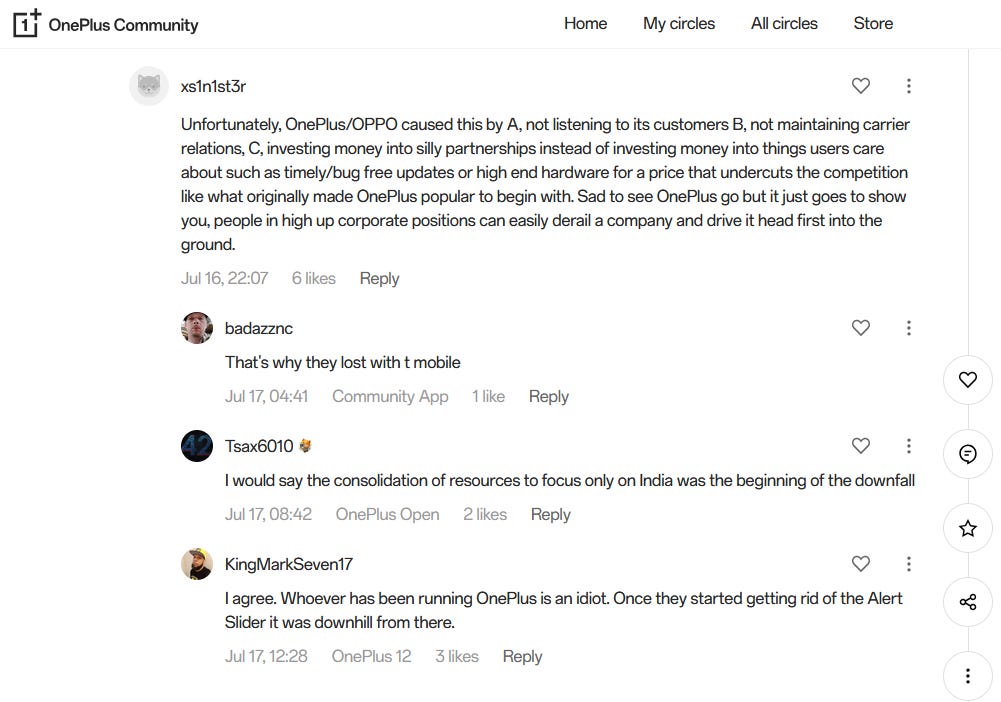
As OnePlus rapidly expanded its product portfolio, the company gradually evolved into another mainstream smartphone manufacturer. Instead of focusing on a small number of standout products, it began offering flagship phones, mid-range devices, budget models, tablets, foldables, smartwatches, and more—many priced similarly to competing brands.
In the process, the identity that had defined OnePlus as the “flagship killer” began to fade.
The broader product portfolio also placed increasing pressure on the company’s relatively small engineering and software teams. Product quality became more inconsistent. Cost-cutting measures became more noticeable, build quality was no longer as distinctive, and software stability declined.
Perhaps the biggest frustration for customers was software support. New devices often launched with bugs that remained unresolved because development resources had already shifted to the next product release. Software updates frequently took months to arrive, and post-launch support became increasingly limited, with patches often reserved for only the most critical issues.
Even the flagship models, while receiving somewhat better support, fell short of the expectations OnePlus had originally established.
In 2020, Carl Pei left the company to establish Nothing.
A year later, OnePlus and OPPO announced a much deeper integration. Over time, OnePlus devices increasingly shared the same hardware platform and software foundation as OPPO products, making the distinction between the two brands less about engineering and more about branding.
This week, OnePlus announced that it will conclude future product launches in North America and Europe as part of a global business adjustment. Existing customers will continue to receive the software updates, security patches, warranty support, and after-sales service originally promised for their devices. The company also confirmed that eligible devices will have the option to transition from OxygenOS to ColorOS in the future, while its regional community platform will be retired.
Whether viewed as a commercial necessity or a strategic realignment, the announcement marks the end of an era for one of Android’s most influential challenger brands.
For me, the biggest lesson isn’t about smartphones.
It’s about brand perception.
A company’s brand isn’t defined by its advertising, its slogans, or what it says about itself. Those shape expectations—but they don’t define reputation.
A brand is built through the decisions a company makes and the experiences it consistently delivers.
Every product launched, every feature removed, every customer interaction, every software update, and every strategic decision either reinforces or weakens the promise a brand has made to its customers.
That’s why perception changes long before a company updates its marketing.
People don’t judge a brand by what it claims to be—they judge it by what it repeatedly does.
Innovation follows the same principle. Companies don’t stop being innovative because they stop talking about innovation. They stop being innovative when they stop making the bold decisions and taking the calculated risks that earned customers’ attention and trust in the first place.
As the saying goes, actions speak louder than words.
Brand perception is earned through consistent actions—not marketing campaigns.
Sources:
Company Announcement - https://www.oneplus.com/us/adjustment
Company Community Note - https://communityus.oneplus.com/thread/2170721842677940232